www.kickstarter.com/projects/
Friday, 12 October 2018
A shameless plug!
As some of you may know, I am quite the fan of "old skool" dungeon crawls, ie anything that may be associated with Heroquest, Fighting Fantasy and so on. Luckily I am not alone in this, and I am happy to help promote this awesome project on Kickstarter.
www.kickstarter.com/projects/
www.kickstarter.com/projects/

Tuesday, 13 March 2018
Book review: Mark of Chaos
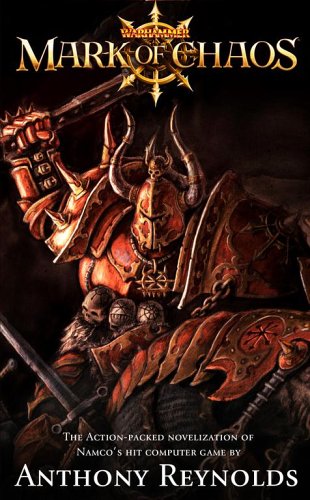
It is generally unwise to read books that are based on computer games, I should think... There is at least one other awful one out there for Warhammer fans, and this one is hardly a hidden gem or anything. To be fair, I must point out that I never played the game, so I don't actually know if it follows the plot and structure of the "story mode" or whatever they may have called it.
This takes me directly to one of the major weaknesses of the book: It is essentially a series of quests, basically from the perspective of two characters, one good, one evil. Again, this may be how the game was played, ie a career of some sort for either a good or evil player, or maybe just the good. I won't be revealing too much by saying that the title refers to the back story of the protagonist, and that he does prevail in the end. A few twists and turns along the way, but nothing major, if one is a veteran reader of Warhammer lit. What may irk some is the loose stringing together of quests/battles featuring characters that tend to be a bit two-dimensional. People who play a lot of video games may not be bothered by that, or at least used to it, but there is no attempt (presumably as per instructions) to hide that the game is the basis of the novel. This also comes across in the choice of races featured. They don't quite manage to throw them all in there, but some appear in only the most basic way and seem to have the literary equivalent of a walk on part, or perhaps cardboard cut outs.
Reynolds is certainly one of the better authors in the Warhammer gallery, and you can't really fault the writing. There IS no room to flesh out the characters or give them more convincing motives or personalities. They're all painted up stereotypes, moving along. There is a good pace, and the book is so easy to grasp, follow and digest that it is a very smooth and quick read. That's not an entirely good thing, and I wonder how it was an author, to basically sit there beefing up a computer game, rather than allowing a plot to evolve more organically. This said, I can't fault the effort at all, and I imagine that all boxes were ticked by editors. There is perhaps a bit of idiocy along the way with people who have killed "thousands" (Really? One guy? How many folks live in the Old World?) and some questionable strategies in the battles, but hey...
Details to flesh out the setting are quite minimal, and anyone familiar with Warhammer already will certainly not read this and learn anything. In fact they are at a disadvantage, as the plot would be more interesting to a complete novice, although one may not have a clue what these skaven (spoiler! Gasp!) are about, and how they live and what they do, even after reading the book. Maybe that's meant to entice you further into Warhammer, or maybe it all just had to be kept under 400 pages, so the skaven received a bit less love than they deserved.
All in all, I would recommend this book to kids, parents who read to their kids, commuters, snowed in folks or perhaps fan of the computer game. As an adult, I felt a bit like I had been eating from the kids' menu or something.
I give it two and a half skulls. Three, if you are 11 years old.
Thursday, 22 February 2018
Book review: Hammers of Ulric
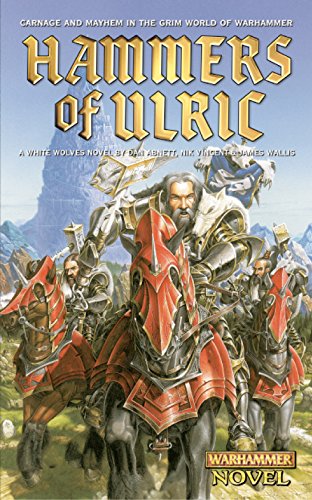
Another one of the older Warhammer books fell into my lap, and I was not disappointed!
The cover is a bit arse. Sorry, whoever the artist is, but while I can see how this deserves some praise for actually being a relevant cover, as opposed to some of the other older books that just got a random badass on the cover, I can't say that I am impressed with the quality of it. The style is somewhat wrong, and it doesn't quite fit the mood of the book either.
I expected it to be a bit of a Warhammer Fantasy BATTLE book featuring the White Wolves prominently. I was wrong. While they are indeed featured heavily, there is far more complexity to the story. First of all, it ties together several "main characters" who each star in different tales spread out over the seasons of a year in Middenheim. This works well, and it may take you a while to realise that these are in fact interconnected and not simply novellas thrown together based on a shared location. Obviously now I have 'spoiled' as much for you, but still. This means that some parts are more of a detective story, other parts are about templars and heroism (or lack thereof) and other parts are harder to pin a genre to. It all comes together in a climax that one may or may not find enjoyable, but it's quite grand and neatly bundles up the story, while leaving enough open ends that they could make a sequel to the book, or indeed a whole series. I have not bothered to find out if they did, but I would read on if they did. All in all, it was more of a Warhammer Fantasy ROLEPLAY novel, as the older books tend to be, and there is no army gathering in the North and no big battlefield where army lists are made flesh for readers/consumers to enjoy.
There are a few characters who lack depth in this, but to be fair, there is a large cast of supporting characters, or low-level main character. Some of these are obviously a bit cliche, but if you read enough fantasy novels, you come to accept that or switch genres. Other characters are quite good or even very good, and the plot is good enough to keep them all afloat. Too often the Warhammer books have either a decent plot with two-dimensional characters, or a bad plot where strong characters end up lost in idiocy. This book has a pretty good balance. Dieter Brossman, the priest of Morr, is perhaps the strongest character, and the knights - some of which seemed Dumas-inspired - are largely decent, except for a few "Red Shirts" that a can reader can perhaps pick out as filler marked for death...
There is an enjoyable amount of info about Middenheim, one of the cooler settings of the old Warhammer world. Maybe you can't quite smell the place based on the descriptions, but it's a solid backdrop for the story, and it has a little info about the White Wolves and the Knights Panther that readers may welcome, though the Panthers largely come off as a bit naf. Fair enough, I suppose, as it's not a book about them, but they did seem a bit too useless for my taste. Why do templars of Ulric use the warhammer (of Sigmar) anyway? Best not wonder.
The book is supposedly written by Dan Abnett, Nik Vincent and James Wallis. How that worked, and who did what, I don't know. It's a fairly seemless blend, or at least they've managed to edit it together with consistency.
I give this book four skulls out of five and recommend it as solid.
Tuesday, 30 January 2018
Book review: Valkia the Bloody
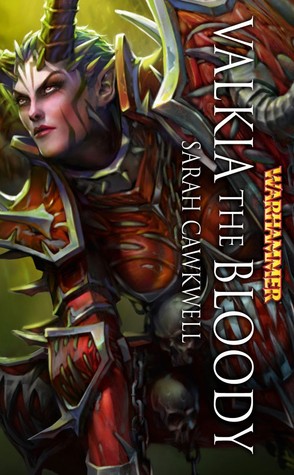
Still reading a Warhammer book here and there, still feeling the need to share my reviews of these masterpieces with the world. Sadly, there was no gem unearthed this time as I read Cawkwell's "Valkia the Bloody". It's rather poor.
First off, let me say that unless one likes Chaos and Khorne in particular... it's best to just skip it altogether. I am not a "Khorne Man" myself, but I have enjoyed a great many other Chaos-themed books from GW, so I fell in. That said, this book is heavily geared towards fans of the BATTLE aspect of Warhammer, rather than those (of us) who may prefer a more RPG-oriented take on the universe.
Avoiding spoilers here, so it's somewhat limited what I can reveal, but I'll reveal a little nevertheless as there is really absolutely no mystery to this book, except perhaps "What happened to the baby then?" which I will just throw out there so that those of you who read it can wonder with me. Unless a chapter was torn out of my copy, there is no answer to that, and I suspect there probably was an answer to that question in some draft of this book, and that it was edited out to cut down on the page number. Anyway. Part of the problem is that Valkia's life is in fact somewhat boring, Eventful, yes, but lacking in surprises for the seasoned reader of Warhammer lit. Or any lit. Or books of any kind. Any kind. Even very short ones. The intrigues are not very sophisticated and Valkia herself is somewhat boring, charmless, and not even really a chip off the old Red Sonja/Xena block, but kinda hard to love or hate. So basically the whole thing is a bit like a Manowar-song only with a female main character at the center, and I really don't mean that in a good way.
There's a sense in which Warhammer Fantasy always seemed different from 40K in which the gods are much closer to the regular (meta-)humans. As in... you can go visit them. Their plots are small, like giving one person a hard time or something. In 40K it's all on a much grander scale, and lesser demons get to corrupt entire worlds, and wars between species or populations are fought when gods yank strings. In this book this difference is notable. Khorne apparently notices a random barbarian girl, Valkia, and takes a shine to her. Eventually she becomes his bride, consort, girlfriend (ooooh!) or something like that. He gives her horns and wings. She gives him skulls for his den and throne. Meanwhile, in 40K, Imperial Guardsmen fight other Guardsmen turned traitor who can't quite manage more than scribbling forbidden symbols and praising "dark gods" that they have little concept of with some atrocities.
I have spoken in other reviews about the joy of getting some juicy background info, even when the book is otherwise crappy. Sadly... No dice. The setting is so generic that no one could pin it on a map. That seems to be on purpose as well. "North" is all one can say about it really, as the names of the characters are a random mix at best. There is Valkia, her father Merroc (who seems to speak some pseudo Scandinavian to her), her brother Edan, her daughters Eris (!) and Bellona and a Kormak (there's another Kormak in another book, also Chaos-loving) and her "barbarian" tribe are the Schwarzvolf... So yeah, you figure out where how the names fit together with a place, because I sure as hell can't.
The author can't quite make up her mind about the tribe's religious practice. Do they honour The Four or not? When? How? Even if the tribe is originally small in number, it seems to also be small in terms of history or culture, apart from a few basic gender norms and a political system. Even Khorne worship, something stupendously simple, ie "kill something and shout 'THIS ONE'S FOR YOU, BIG GUY'!" is not really very clear. Sure, I get that Khorne doesn't care whose skull he gets, but Valkia apparently thinks that it is a "great honour" if she puts your skull by her boyfriend's char, BUT at the same time it's also where you throw the skull of a chubby traitor. So yeah, the background is poor at best and one might describe it as generic.
Is there nothing good about it? I can't think of anything, really. Maybe if you're very visual and get off on imagining shapely devil-girls based on the author's somewhat unimaginative descriptions? Or if you feel it empowers women that Valkia kills a great deal of men (and some other women) in this book? Look, it's poorly written. It reads like the voice over to a real crime show on the Discovery channel, and Cawkwell has an annoying tendency to throw these "one liner" sentences in at the end of a paragraph, like "The slaughter would soon begin" and even "and hell followed with her" if memory serves. Cringeworthy stuff, really.
I am giving it one skull out of five, because I enjoyed imagining a shapely devil-girl, and because Khorne will want the other four for his throne.
Subscribe to:
Posts (Atom)