Showing posts with label warhammer. Show all posts

Tuesday, 10 March 2015

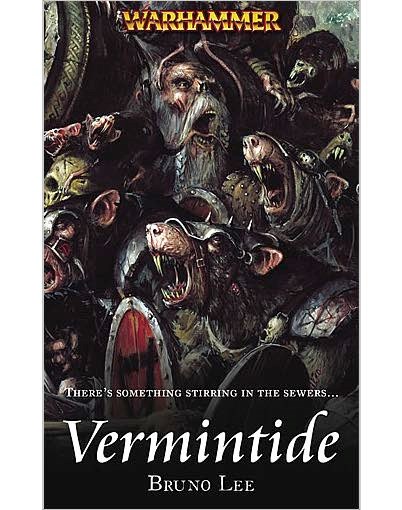
Book review: Vermintide


I picked up "Vermintide" because I was asked if my collection of Warhammer novels included any with skaven in it. The answer was pretty much no, with there being a bit of skaven in a few of the ones I had, but none that were primarily about skaven, as I have not got the Thanquol and Boneripper-series. Fortunately, there was this book which was by an author unknown to me and not part of a series.
 
I was not technically correct about any of those things, apart from skaven being prominently featured. The author is C. L. Werner, a man with many fans, including a few in my circle of friends. I count myself as a sometimes fan, as I like some of his books (Wulfrik, Palace of the Plague God, Blood for the Blood God), but not all (Forged by Chaos? What a a piece of...). I find that I like his work best when it isn't a fry up of a film, so I have steered clear of the Brunner books so far, but I may dip my toes one day if I hear persuasive arguments in favour. So yeah, Bruno Lee is a pseudonym. I guessed as much when I bought it, but never checked whose.
 
Second of all, the book kinda ties into other works, as it has some characters familiar to veteran Warhammer readers and a few references to other "famous" Warhammer characters who are simply mentioned in passing. Some may find that awesome, either because they like that sorta familiarity, or because they like the sense of an elaborate tapestry where all the books are connected and fit neatly together. They usually don't though, so I suppose one solution is to just have the same four guys write most of them, and that plan is fine, if you've got the right guys.
 
Is Werner the right guy? The plot was good. I won't reveal it, but of course it involves tunnels full of foul ratmen with fiendish schemes, treachery both among human and skaven alike, and some characters that are quite cool, along with some that are... less cool. As usual, Werner has quite a good rogues gallery, and the villains are very villainous indeed, making (most?) of the protagonists seem more generic. The hero, Heiko Geissner for instance? No mental image of him for me, and he came across as quite generic, even if I have come to appreciate older heroes as I slide further and further out of the "intelligent late teens boy"- reader segment. There were some attempts at explaining motives, pitting different morals against one another, etc and I was quite impressed with that in a 250 page novel where stuff all does blow up. It managed to not seem too added on or annoyingly out of place, and the only thing some readers might not like is how Werner has a tendency to kill off quite a few characters, often in a way that's best described as callous or unceremonious, so... brace yourselves for that.
 
Oh yeah, and seeing as how it was the international Women's Day yesterday: There is absolutely no female contribution in this whole book. Well, if there is, it's part of the backstory for a character, and that woman was a whore. So... Yeah. No Xena, no Pippi, no Hillary.
 
I did like this book, primarily because I thought the plot was fairly solid for what it is, and because it made very good use of its 250 pages without there being either a need for more or any point where it dragged on to no use. Like I have said before, some of the longer books have pointless long "A to B"-sequences where your gamemaster would roll dice for a random encounter if this was a night of RPG'ing, but when you're down to 250 pages this is most often avoided, and things don't get too complicated to be resolved with a big fight at the end.

I give this four stars out of five*. This was like a nice warm soup, hearty, but maybe not very filling.


*Maybe three and a half due to the character with the Trainspotting accent who just always pisses me off. 

Friday, 12 December 2014

Book review: The Enemy Within

Not to be confused with the elaborate (?) campaign for the Warhammer Fantasy Roleplaying Game, this book offers good entertainment for the ... thinking young man.


I read somewhere that Warhammer books were at some point written with instructions to write for a mature 18 year old boy reader. As I am now significantly beyond that age, I should perhaps pause and question my reading habits. "Really? Pulp fantasy novels at your age?" There. That's that done. With that troublesome introspection out of the way, I will say that I do not actually believe that to be true. Several books are clearly written for a younger audience (or an immature 18 year old boy, ie someone who is about 14) and I have reviewed some here, and this one is clearly for an older or more intelligent audience. You, dear readers. Of course.

This is the tale of a wizard and his attempt to infiltrate a cult of Tzeentch worshippers in Altdorf. As you can no doubt guess, this involves a struggle to hold on to his sanity and his morals along the way, as he faces all the troubles of the undercover agent, and wrestles with moral issues and psychological issues. This is of course dangerous territory as the pitfalls of clichés are many, and it risks becoming a bit ham fisted with only 250 pages to tie up the plot, throw some personality on the characters and so on. Somewhat surprisingly, it works out okay. No massive surprises or sage wisdom, but a hard tackle on the difficulties that characters in the Warhammer World would no doubt encounter in a brush with Chaos.

Oh, and there is some (non graphical!) sex too. One of the characters is even a prostitute. This is not something usually handled very elegantly in Warhammer books. Not that I think a lot of the books really need it either, but with a host of literally sex-less creatures in the Warhammer World(s), it is nice to see not all sexuality blotted out from the books, or neatly packaged as "that Slaanesh stuff". Not that I mean to go off on a rant about it it either, but I am sure the "mature 18 year old boy" reading this will appreciate the odd ... bit of sex.

Another good thing is that the plot does not feature large scale warfare. I have talked about this in other reviews too, and I do like it when Chaos is the worm in the Empire's apple, rather than just the sweeping tide of mayhem from the North. This book is full of the former type of action, and that suited me quite well. In fact, I could have played out almost all of the plot in the book with miniatures that I own, and on a small coffee table, so no huge armies or anything for you to wrap your imagination around.

Certain things in the book may happen a little too... smoothly. I think that has to do with the constraints of 250 pages vs 400 as some of the other books offer without having the need for them. It is nit-picking really, but sometimes books suffer from not having any ... non-useful characters. What I mean, is that when there are not enough characters to cover a great many possibilities, then sometimes you can work out the plot a bit too soon. There is nothing to throw you off the scent, you might say.

This book contains less/none of the tongue in cheek humour that blossoms in some of the other books, and you won't find characters whose German names makes your eyes roll back, or quite the poor attempts at wit that some other books tend to have. I kind of liked that, at least in this particular book where it would have felt particularly misplaced.

In conclusion... I really enjoyed it. I do tend to enjoy this TYPE of book/plot though, so the odds were pretty good, as long as nothing went wrong or turned too stupid.

Overall rating: 4 out of 5. Like a nice burger, cooked to perfection and dressed right. Not a culinary wonder, but good eating.

Thursday, 27 November 2014

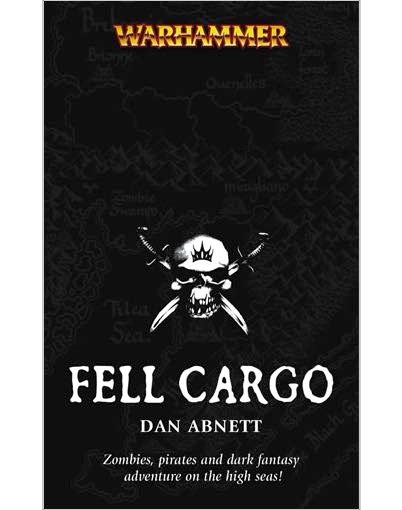
Book review: Fell Cargo

I have ploughed through a tonne of these pulp fantasy/space opera books set in the Warhammer universe(s) this year, but I figure I will only read one like this, as it is a genre piece about pirates.


Maybe this was part of some GW strategy at some point to try and sell us their gameswith ships in it. I cannot be bothered to check a timeline for that possibility, but suffice to say, I do not recall there being many other books about Sartosan pirates from Black Library. If there are, then kindly inform me. Or maybe Dan Abnett just gets to write whatever he feels like writing these days? That would suit me just fine. I hate it when you can FEEL that the author would much rather have written something else, or indeed that he DID write something else, but the work was changed to fit into some release schedule or even the setting as a whole.

The book is of course riddled with cliches, or "fixtures" if you will, from pirate tales. It reads like a (better) "Pirates of the Caribbean", and it is neat mix of tall tale, horror story and swashbuckling adventure on the high seas. Sea monsters, pirates of any stripe, villains, heroes... The book seemed to have it all, and it is written with the same quality that Abnett usually provides. The only thing that I do perhaps not like as much as the rest of the details in the book is the joy the author takes in naming various bladed weapons and... firearms. Not that I don't appreciate details, and we are not at a Melville level of educational info about something, but I had to look up several of these along the way just to find out what to visualize in combat situations.

There are few surprises in this book, but there probably should not be a great deal of surprises either, if this was to be the pirate yarn it set out to be. While other authors, desperate for a tiny twist, kill off some characters that you might have expected to live or make someone a surprise traitor, Abnett manages to kill off the right ones and at the right time which is something of an accomplishment at this point. Added bonus? No characters who'll annoy the piss out of you as some other books might eagerly provide. The "young lad" who comes of age in this book is not so young or so naive that it becomes painful, and there are no talking parrots or monkeys or what have you to add comedy. The worst? A few one liners that you see coming a mile away.

The books is only 250 pages. Could it have been 400? I doubt it could without getting boring or requiring more meaty subplots.

Over all I give it 4,5 stars. A seafood platter with everything on it.


Monday, 1 September 2014

Book review: The Burning Shore

Recently both my painting and converting has been on a forced hiatus (redecorating my "studio"), but I have been reading a bit... 

I picked up "The Burning Shore" because it had a few things going for it, obviously. It seemingly had enough quality to spawn two sequels, and I THINK I recall there being miniatures for the pair of (dubious) heroes? Perhaps my old mind plays tricks on me, but nevertheless, I picked up the book (for a song, of course) with expectations... somewhat above average.

As mentioned in other reviews, I like a bit of exotic info in my Warhammer fiction. That is to say, I like a bit of pulpy tourist lit where I as reader can learn about exotic corners of a fictive globe and/or about exotic races and creatures. However, as the sayings go... "Be careful what you wish for..." and "too much of a good thing..." That is perhaps the major problem here: The book is basically a stack of cliches and it offers no surprise what so ever in terms of plot. We have a coming of age story where our hero Florin D'artaud is uprooted from his native Bretonnia with his friend/servant Lorenzo and travels to Lustria. Gradually he matures into a capable mercenary leader and the pairs adventures are as predictable as they are colourful. That is to say, there is nothing MISSING in terms of plot, but the plot is just not that satisfying. Like... Given the elements a seasoned reader would easily come up with something along the lines of what the book contains.

Is it well written then? Yes and no. The details are many, the descriptions are just fine, but it is not riveting at any point really. I was left with the feeling that had the plot been better, then Robert Earl could have treated us to something better, as it seems he had the tools, but did perhaps work to boring specs. "Write us an extended bromance with Old World mercenaries and lizardmen for when the new army list comes out." Something like that.

Another thing that may annoy the piss out of not just me: The Tilean mercenary captain. Why? Well, I have seen "Allo Allo"... Laughing at national stereotypes and pidgin English is just not my bag, bay-by. Well, other than in that whole Warhammer World way that we of course all buy in to it, but still. Ham-fisted.

The book was not packed with nuggets of info, but it was fiiiine in that sense, I guess. I learned that Lustria is a jungle hellhole full of insects, lizardmen, more lizardmen, predators and more lizardmen. It is hot and humid too, and a bitch to get to. All duly noted.

What is perhaps most frustrating is the fact that Florin and Lorenzo both seem like they have virtually no depth at all. Their bromance is not quite explained in any way or made all that believable, and neither have much of a personality. They are both supposed to be quite rogue-ish, but this just does not hit home to a point where you love it, hate it or love to hate it, and the book would have been vastly more interesting if this had been probed a bit better and somehow gotten further.

Over all rating: 2 out of 5.

Sunday, 23 March 2014

Book review: Riders of the Dead

Ahhh, Dan Abnett.... So we meet at last. in keeping with tradition, I pay minimal amounts for old books, and so I managed to get my talons into this fine specimen :Riders of the dead by Dan Abnett, primarily known for his 40K fiction.

This is the story of how two brave soldiers of the Empire end up fighting on opposite sides in the great war with Archaon's forces. Clearly, this means that one is corrupted horribly while the other ... isn't. All depending on one's personal tastes, one may find either of the characters more interesting, but it does effectively mean that we have two main characters, two protagonists, only on opposite sides of the mirror. One is Karl, the other is Gerlach, and both assume new identies as the story goes on, and so this tale is a classic "coming of age" in the sense that while these people may be grown men, they are not yet matured by life and circumstances, until fate forces them to leave behind their lives as imperial lancers.

Karl - let me spoil it for you right away - becomes a champion of Tzeentch eventually. He rides with the Kurgan, accepted as one of them, after a long series of trials and tribulations, and we learn quite a bit about these vicious Northeners and their ways. The characters in this narrative are perhaps a bit better than in the other with a nice mix of "he's going to die in a minute"-people who are quickly infused with enough of a story that we care, and genuinely cool characters (the noble Von Marburg is excellent, for example) who deserve the pages they are given.

Then there is Gerlach who ends up in Kislev. Much like Karl becomes one of the Kurgan, so Gerlach becomes one of the Kislevites, adapting to their customs, and indeed to their philosophies. This is probably where the book is at its best, because though Gerlach is perhaps not the most interesting or likable fellow (to begin with) he is thrown into a culture that Warhammer has always treated as an afterthought. Whether or not Abnett's take on Cossack/Kislevite culture is accurate, I have no idea, but it is both believable, interesting and quite cool. The books title, by the way, come from the Kislevite tradition of treating winged lancers as dead from the moment they ride out of their village.

I like this book for many reasons. It offers the level of detail that makes a simple plot work, and it does so by focusing on two neglected areas/cultures. Chaos often comes across as this mindless, somewhat dull crowd of "let's just slaughter you all for the hell of it"-crowd that you cannot really find much amusement with except for the sheer bad assery of it all with the helmets and armour and all, but not many books offer any sort of insight into WHO wears the helmets and armour, or indeed WHY, and Kislev is even more neglected (and sometimes appears down right silly with fur-lined hats, dancing bears, icy tap magic and so on), so this was a most welcome bit of anthropology.

I'll leave you guessing who wins the battle that you have no doubt guessed takes place in the end.

My hat is off to Dan Abnett for this book. I must admit I feared he'd gotten to write a string of Warhammer books for some completely unknown reason (like a few other authors it seems) whilst possessing only a moderate amount of talent or work ethic. It does not seem to be the case, based on this novel at least.

Over all rating: 4.5 out of 5. Genuinely interesting and well written. Simple plot, simple characters, cooked to perfection.

Monday, 10 February 2014

Book review: Magestorm

I actually read this a few weeks ago when I was on a business trip. I find that these books are ideal for a trip on a budget airline with all the waiting and needs for distraction built in to the whole thing. This book perhaps more so than others... And that's not a compliment.

This is, sadly, another example of where Warhammer books become these sad instruments, this filthy mixture of advertising and teaching tool. Usually their stock and trade are.... well, stock characters, cliches, mass destruction, and these frighteningly shallow characters who are basically these odd Moebius strips that have a certain personality because of what they are, and are what they are because of their personalities. Explanation? Not needed, but basic and from the "so, what have you come up with for your Mage character then, Carl?"-category that anybody who has ever actually sat down and thrown dice across character sheets will recognisze. Sad, mr. Green. Sad.

Lets run through the plot. It won't take long. A mysterious (Really? Not to me, man.) fire mage is caught up in the fight against Archaon's invading forces as some staunch defenders try to prevent Wolfenburg from falling. Also featured: A warrior priest, a witch hunter, some other wizards... Everyone doing exactly what you might expect. As an aside... Does anybody know of ANY Warhammer book where there is an even remotely cool Jade wizard featured?

Our main character, Gerhart Brennend, has a fiery temper, a noble heart, but his liasion with magic, the very stuff of Chaos does of course set him apart... No surprises here. And we are at it with the German names again, obviously. I have heard that it's considered a "love it or hate it"-thing, but I find it mildly distracting when it gets TOO thick, or when we encounter yet another slew of people with the same handful of German first names. THEN I get annoyed, but normally I can stomach it just fine. I am tolerant. Laid back.

Almost all other characters are worthy of little attention. Some are pretty cool, but with no depth. No twists, no surprises.

Is there nothing good? Oh Green CAN write, and probably does it best when it is about the spellcasting itself. However, I have read other books by the same author, and this one is by far the weakest. If I was not a fan of magic, Chaos, etc, I would have been in a worse mood when I finished it, but it was adequate, and might be a great primer for someone new to Warhammer.

Rating: 2 out 5. Empty calories. You'll be hungry again soon.

Sunday, 10 November 2013

Book review: Marks of Chaos (two books)

Work has been riding me hard lately, and I haven't gotten any modelling or painting done. Hopefully this week, perhaps even later today. Meanwhile, I have managed to read some books by James Wallis, and you should too. Go. Now. Read these.

Of the somewhat frightening amount of Warhammer books that I have read, I must say that these are so far the best. By a mile or so. That's not counting Warhammer 40K where people inform me that there are some other juicy finds, but this two book series so far kicks the crap out of any other Warhammer book that I have read.


The plot is GOOD. We follow the downward spiral of Empire soldier Karl Hoche as he becomes... touched by Chaos and embroiled in plots that threaten the security of the Empire and involve several secret organisations. It is perhaps not so much a descent as it is the deconstruction of Hoche, and a transformation into... well, lets not give it all away here. This takes place as Archaon's hordes march on the Empire, yet there are not many big battle sequences and tedious "Battle reports", so do not avoid this book just because it plays out among big name characters (Luthor Huss, Valten, Gamov) or take place during one of the great metaplot events in the Warhammer world. It remains a personal story of one man's doom, and we are not so swept up in big events that we lose track of individual character's humanity (or lack there of), motives, feelings, etc. Basically, this book is about what someone does when having lost everything, and fighting a losing battle. It is about defiance and survival, about making the most of situations.

The writing is crisp, and the plot is intelligent. I was not bored at any point, and that was not due to full on action non stop, but rather due to a clever balancing of mystery, paranoia and dread. Hoche's world is grim, and Hoche grows grimmer and grimmer till he fits it. It is a trust no one story (slightly undermined by the presence of famous characters) of personal horrors that plays out among big events. We are treated to enough details to get a distinct sense of the Warhammer World, and so this is not a story (like some others I have reviewed) that could be transported to a different fantasy universe with a few minor alterations. It is Warhammer through and through without selling you any miniatures or games, something which is rampant in other Warhammer books. Wallis writes good characters, believable and multi-faceted, imperfect and interesting, and he writes a good anti-hero. Combat scenes are mainly quick and dirty, the violence is gritty, and Chaos is truly horrific, disgusting and ... everywhere.

Is there nothing bad about this book? Well... I suppose some might find it a bit cynical at times. Again, I do not want to give anything away, but there are several characters in the book who come to a largely undeserved end. There is no justice in this book. This is like Clint Eastwood's "Unforgiven" with a vengeance in the sense that life sure as hell does not reward the righteous and punish the wicked, so prepare to give up a few "aww, maaaan..." along the way. Looking with critical eyes on this book, it may even be said that the nicest guys finish last, or rather, that they come to the most brutal early deaths. Is that intentional? Possibly. Hoche is not a hero, and he is not written as such either, and so he possesses a hard edge that few of us would hope to have, and he may not even go down as very likeable. I think that IS the point, though.

Rating: 5 out of 5. Dog's bollocks. Warhammer World as it should be.

Tuesday, 29 October 2013

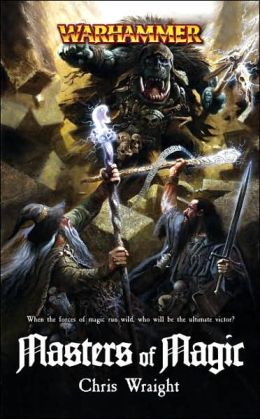
Book review: Masters of magic

I know, I know... why is he just reading when he could be painting? I actually read this as I travelled for work recently. It is pretty much perfect for that, as it is an easy and not terribly complicated read. I mean that as a compliment, really.


Seldom have I enjoyed a plot as basic as this one, so kudos to Chris Wright for managing to make (most) the characters interesting enough to captivate me and making a lot of a little. True, I am a sucker for wizards hurling lightning bolts at one another, but I like to think that there is some lower limit to what I will accept, and this book was well above.

The plot in short: A young grey wizard encounters an army of orcs led by a shaman. Stuff happens as the orcs rampage towards Altdorf, and more wizards get involved, some as part of wizardly intrigues and power struggles, and we are treated to many wizardly things, such as spellcasting, arrogance, manipulation, heroics and all such juicy things for the eager reader. It's all written fairly basic, vibrant and with just the right amount of depth for each character to make some sense and spawn some interest without anyone ever actually getting very complicated or too full of plot hooks (even though a number of famous Warhammer characters make at least an appearance) to be useful in the tale. I think we can all guess with some level of accuracy who will make it through this story alive, but there are a few surprises along the way.

So far, all good. Another good thing? The orc shaman. Described much like the shark in "Jaws" or some such, we don't get the god-awful attempt at describing things from his point of view. There ARE enough characters to switch through as it is, and none of them are too complicated, so adding another would effectively detract from both the added character and the ones you had already. The danger when describing battle wizards of the Empire always seems to be that one ever so easily ends up writing some cliche-ridden characters who each just embody their college, OR you end up with someone who is the polar opposite, because of how curious and interesting THAT would be... So yeah. Orc shaman who remains orcy? Big plus. Battle wizards who don't go too overboard in cliches? Big plus too. (Some of them may be a bit stereotyped, but fair play, mr Wraight)

I was recently asked if all of these books aren't just "one big battle scene after another". I strongly denied that filthy suggestion, but... Well this one kinda is. Let's not pretend that it does not contain a strong amount of spellcasting and violent battles. It does. the book is perhaps intelligently put together, but it would be a stretch to suggest that it contains much mystery or information. There is of course information about the colleges of magic, a tiny bit about spellcasting and greenskin magic, but that's all the cultural fluff/depth you get. No exotic region, no craftily hidden references for initiates (not me at least) and not much to make you cry out to dark gods for a sequel either really, though I imagine some of the characters turn up elsewhere, perhaps in Wright's other books.

Over all rating: 4 out 5. Solid. Delivers. "Give him the ball and he'll score."

Wednesday, 16 October 2013

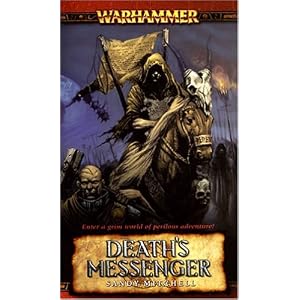
Book review: Death's Messenger

I threw myself into "Death's Messenger" in damn near complete ignorance it seems. I foolishly thought that it was perhaps written by a woman (Sandy?), but I was wrong. It's a pseudonym. It says so in the back of the book. Not sure I understand what the purpose was then, but hey. Secondly, I had not grasped that this was in fact part one of a series, and so I sat there throughout the book, admittedly LIKE A MORON and kept wondering HOW miss Sandy would manage to offer a satisfactory ending to the tale as the pages vanished.


As usual, I will not spoil the plot much. It's a coming of age tale, a grim one at that, as young Rudi is forced to flee his village in the rural regions of the Empire. Antagonists are many and of every stripe, both village bullies, beastmen, skaven, zealots, cultists... You name it. In retrospect, it all calls for elaboration to make much sense, but it is such an easy read that I was perhaps misled into thinking that it just wouldn't be explained or fleshed out much. Young Rudi goes from a somewhat stunted upbringing in the woods - and yes we get it several times: he grew up in the forrest with his stepfather, he thus has little sophistication and few social skills - through a brief career as mail man in his local community and straight to fugitive in a Mark Twain-ish story.

What's good? The writing is fairly crisp and vivid, not too meandering and pretentious, not too simple and repetive. The characters ... well, a lot are RPG-stock, including the main protagonists. Painfully so, some might find, but some of us may accept it as part and parcel with Warhammer books. I wasn't too bothered. It was like drinking Guinness. You've had it before, but it's still good. It IS a very easy and somewhat predictable read where it's fair to say that many veterans will understand more of what's going on than the characters. It's a classic problem in these books, and so is the "it does drag a bit"-sequences when characters are "between" major plot elements, and you can figure out where stuff is going.

The plot does seem genuinely complicated and "large" enough to keep young Rudi occupied for two more books without too much (literally) wandering in the wilderness to finally manage to bore me.

There is not much - if any - new info in this book. Nada. No nuggets if arcane knowledge, no explorer's joy as we visit new and exciting regions. We do not really visit any regions at all actually, as it's all very generic "fantasy landscape" where monsters lurk in woods, villagers struggle in ignorance and adventurers do cool stuff. Everyone has German sounding names, but they could have had any names, anywhere, and it wouldn't matter much. There's a little flavour involved when it comes to Chaos (a specific god that it won't take big brains to detect for the seasoned Warhammer reader), but that's it really when it comes to slightly less generic stuff.

It ends in a cliffhanger. If you hate this sort of thing, or don't fancy reading a whole trilogy then skip it altogether. I think you can miss it and not kick yourself, unless you're reading it so that you can join a roleplaying game and roll your eyes when your gamemaster steals from it, or something that he genuinely thought up accidentally resembles parts of this tale.

Rating: 3 out of 5. Spaghetti bolognese.

Thursday, 26 September 2013

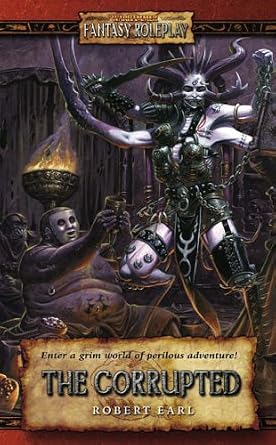
Book review: The Corrupted

Robert Earl has long been on my radar, that is to say that I have noticed his name and have another of his books lying around (unread), so I gave "The Corrupted" a read.


The plot delivers a few twists, so I won't say too much about it. It features a fat wizard and his apprentice travelling North in search of another wizard who has become corrupted by Chaos, as well as a band of Witch hunters in hot pursuit as well. I don't know if I ruin it for anybody by saying that this all turns pretty ugly along the way, the further North they get.

As earlier reviews have suggested, I like my chaos more as a cancer than as a punch to the face. The corruption of denizens of the Warhammer World is a bit more interesting to read about than just somewhat pitiful attempts at describing big battles, be they legendary or not. This book offers plenty of that, and it is fairly nifty attempt to knot together different strands, characters entangled in the same sordid matter. I like how Earl treats Chaos, at least in this book, as something infectious, a stain that won't come out, no matter how hard you rub it.

What's good? It offers some interesting characters, some unlikely. How many obese grey wizards have YOU come across in Warhammer books? it may not be worth the read for that reason alone, but still. It also offers some more insight into wizards in general, though they may seem a bit too ridiculous, comical or silly for some people who like their magic a bit more cool. I think what I like best is the frailty and somewhat pathetic nature of all the characters in the book, though some teeter on the brink of silliness at times.

What's bad? It's too short. Granted, the plot might not have been able to stretch across another 100 or so pages, but I think I would have like to see an honest attempt. At least another 50 could have done the book good, and there was no indication that Earl could not have pulled this off, having a wealth of decent characters and a rich setting to draw upon.

Rating: 3 out 5. A Twix, not an actual meal, tasty but not filling.

Monday, 23 September 2013

Book review: Realm of Chaos

Edited by Marc Gascoigne and Andy Jones, short stories by a range of authors.


It may not exactly be fair to review them all in one go. It comes across as guilt by association for some who may have written a brilliant pearl of a novella, yet find it buried deep in this... book.

I read the collections of short stories, embittered by my experiences with Warhammer novels. Not that they are all so poor, and I have even reviewed some of the better ones that I have read on this blog, but I find that several have too little substance to carry you through a whole book. Inane plots, boring characters with no depth, popular films transported and adapted to the Warhammer world, cliches... all in a flurry of adjectives to disguise the fact that you've paid good money for something that most college level aspiring writers could probably produce. At least with a gun to the head.

As you may have guessed, this one has a few real stinkers.

I'll tell you where Andy Jones went wrong: He put his own short stories in. These are godawful. Grunsonn's marauders are a sad effin bunch, and the comedy is neither funny nor in the right place, as most of the other stories seem to go for a splash of horror. They feature in no less than two stories in this book. Both should have been flushed.

I'll tell you where Marc Gascoigne went wrong: Not shouting "Blood for the Blood God!" and slaying Andy Jones for his awful stories.

There are two stories by Gav Thorpe as well. Some Warhammer enthusiasts may love his work, and I confess I have not read enough of it to truly weigh in with an opinion on his authorship. I am guessing it may be better NOW than when he wrote these two short stories, but to be fair, they are both high enough in quality to warrant being included. Predictable, yet with enough mood and detail. The last one, "Faithful Servant" is actually quite good, open-ended (fairly rare in Warhammer books) and with a good sense of how not to try and make MORE out of just one moral question.

Most of the other stories deserve neither praise or mockery. If I had to pick a favourite, I would say "Wolf in the Fold" by Ben Chessell (who also got two stories in here), though "Hounds of Winter" may deserve a mention as well, with Jonathan Green also contributing two stories.

Maybe I am too picky, but I just did not see anything here that absolutely needed to be published. I sometimes use these books as starting points, looking up the authors to see if they've written more, interesting looking stuff. I have not done that this time.

The book was essentially free, and I paid a pittance for S&H, and the read was quick. I would perhaps recommend it to commuters or young readers, but not to veteran readers or picky curmudgeons like me.

Rating: 2 out of 5. Inspires people to write their own.

Thursday, 19 September 2013

Book review: Storm Warriors

Seeing as I read the other two tales of Orfeo, I figured I would read the third one too, even if I was a bit weary of the trilogy after the second installment. Does it pick up, or is this one long rant about mediocrity? Read on and find out.


Orfeo keeps spinning his yarn to the caliph, and he does seem to have regained some of his talent, and we may consider the previous tale something of a detour, or perhaps a lull. Not just in terms of what the hell it had to do with what the caliph was asking about in the first place, but also in terms of its quality as far as plot and characters go.

This tale is quite clearly Arthurian. Throw it away if you hate all things Camelot-Merlin-Knights-related. Does it need to be? Kinda. We do again explore another corner of the Warhammer World, and this time it is Albion (though it could have easily been Bretonnia without too much tweaking). While the previous tale suffered deeply from its generic setting, this one has much more attention to cultural aspects and various traditions. Thumbs up for that, even though I am personally not crazy about Arthurian stuff.

The plot, briefly. Elves are shipwrecked in the small kingdom of Morien where a young, inexperienced and not exactly awesome king Herla must deal with trouble that arises in connection with that. Rifts grow between the king and his bard Trystan, and between the king and queen, the king and his people, the king and his horse, his mates.... Only kidding about the horse, but rifts grow everywhere, and it all comes to a head in the end. No surprise there.

There are two protagonists as such, Herla and Trystan. Are they gay then? No, I wouldn't say that. They just seem to embody two aspects of Morien's culture and this is fine. Unless one hates the bard-cum-wizard role or something like that. They do have some depth of character, but they are both, as I see it, embodiments of principles, arch- or stereotypes, and somewhat without surprising depths or frailties. Be that as it may, they are after all characters in a tale within a tale, Orfeo's teaching tools, if you will. The other characters... Good enough. No complaints here, really.

Oh come on, you've guessed already that those elves are fishy.

I am perfectly ready to admit that I am no expert in Arthurian lore, so various references, homages or pastiches may have been beyond me. I know enough to detect the undercurrent (that doesn't take much), and I also get the reinvention of The Wild Hunt as the Storm Warriors, even without a strong passion for Celtic myth. People who love this stuff more than I do, may either love or hate this book more than I do. You'll see Merlin, Arthur, shades of Lancelot... Probably more than that.

The other two books dragged in places. This one does too. Let's assume that it's not Orfeo who tells boring tales to the caliph, and let's assume that HE is not paid per word or expected to fill a certain number of pages... See where I am going with this? I think an editor with a red pen would have helped. Such an editor might have crossed out stuff that even slow kids had already gotten, or he might have written "unclear" when it came to certain passages.

Chaos, again, creeps up, rather than invade with heavy armour, horned helmets and big axes. It lurks and pounces on the morally weak, sticks a talon in shortcomings, spreads like a disease, and doesn't just punch you in the face. This is what I like best in Craig's books. The demand for "heroes" who are strong in character, not just in sword arm... it's a plate full of vegetables without much meat, and without a dessert. It makes these books a bit boring at times, it makes the heroes less cool than quite a lot of other characters in Warhammer books, and yet it does not really offer enough food for thought and moral complexity to sort of leap out of its genre (fantasy schlock?). That is of course a problem, but it seems inherent, or structural. The second problem in the trilogy is predictability, but again, many Warhammer books suffer from this, and twist endings can end up contrived and annoying as well, so... Meh.

Rating: 3 or 4 out of 5. Rivals the first book as the best in the series.

Wednesday, 18 September 2013

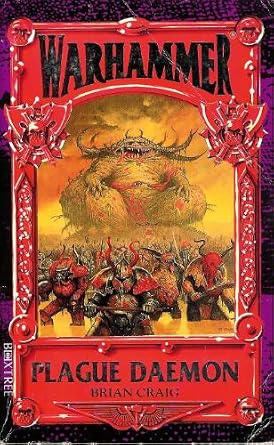
Book Review: Plague Daemon

There are many reasons why I read this book. They are, in no particular order:

1. I read all the Warhammer books I can find that feature Nurgle-stuff.

2. It is the second tale of Orfeo, and I read the first one and liked it.

3. I have liked Brian Craig's other books.

4. I like the earlier, older Warhammer books better than the new ones.

5. It is set in yet another not so familiar region of the Old World.


All these reasons, however, took on the guise of daemons themselves, and they became the very source of my disappointment.

I did not like this book. While there is some development of the metaplot that features Orfeo and his captor from the first book (and this I liked, overall), the tale itself is damn near daft and fairly uninteresting at best. It's the tale of a man-at-arms (and so we are told repeatedly) with the personality of a pack of lunch meats and his struggle to save a small kingdom in The Border Princes from the clutches of the plague god, Nurgle. Again, without revealing much, I think one can say that this features treachery, wizardry and douchebaggery.

I struggled to find one interesting character in the entire book. For the life of me, I could not care less what happened to these people. If Craig (ambitiously) wanted his characters to be more ordinary, "cometh the hour, cometh the man"-type of heroes then... Well, it was a fine thought, but I don't think it succeeded in its execution. It's a difficult task to let your characters mature and blossom into heroes, and they often start out too lame, or go through too much of a transformation. In this case it's more of the former, and it is somewhat predictable as well.

How good is the writing, how rich and powerful the imagery? Not very. While I would be a hypocrite if I asked for the very blood, gore and action that later Warhammer novels offer in spades, I struggled to find excitement in even the most climactic scenes. The plot just sort of drudged along, and the whole thing did feel very much like a tale. A boring one at that, and this book, weaker in terms of plot than the first one, really needed some extra colour... You know, people diving in slow motion as stuff explodes. Nothing ever did.

Is this - like some of the other books I have read and reviewed - a treasure of knowledge? Will wisdom be yours if you read it? Alas, no. The Border Princes, much like Norsca, Chaos Wastes etc. is one of the less charted regions of the Warhammer world, and thus it offers the chance to have any sort of kingdom located there that you may want or need. While it's hardly feasible to go on and on describing details about a place and its culture, this all came across as very generic. It could almost literally be anywhere. As for Nurgle-stuff... Nothing new, no deep insights.

This felt very much like a part two of a trilogy. I yawned, I soldiered on, but I was not terribly amused or impressed. I have definitely seen better from this author, so I was somewhat frustrated by this book.

Rating: 2 out of 5. Boring, a missed boat.

Monday, 16 September 2013

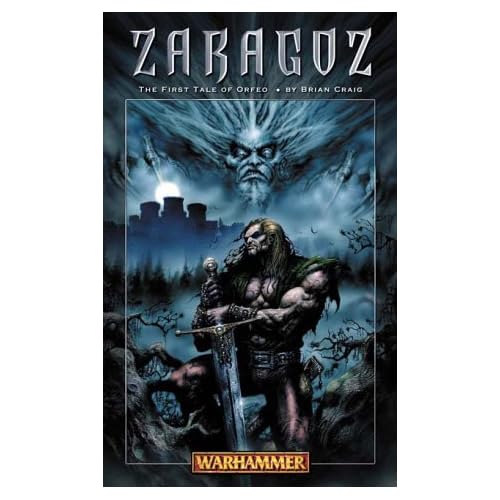
Book review: Zaragoz - Orfeo trilogy 1

Here's another of the older Warhammer books that I enjoyed.


This is part one of three, all completely different books, that are tied together by being the tales of Orfeo, a wandering minstrel-type who is captured by a pirate king somewhere in Araby. His first tale features himself as the main character (the others do not), and it is perhaps the superior story out of the three. The plot - without giving too much away - revolves around the struggle for control of a small Estalian city state where chaos lurks. In terms of genre... Once again, I succeeded in finding a Warhammer book without massive battles, infamous warlords and destruction on a grand scale. This is more fantasy-horror-thriller stuff, though it does drag in parts.

There are two obvious advantages to this book: The settings. It offers rare scraps of info about Estalia and Araby, places largely ignored or passed over quickly by the majority of Warhammer writers. That may have something to do with where the authors are from, but it may also have something to do with the way the Warhammer world has come to be about invasions from the North again and again... Do I like Craig's Eastalia and Araby? I like his Estalia. His Araby is something out of "1001 Nights" with strong dose of Orientalism and some PC "let's not speak ill of this pastiche of that big world religion that some people speak ill of"-sentiment where folks in Araby pretty much appear to be very much like... Arabs. In books for boys, written 100 years or so ago. The Estalians... Well, it smacks of Quijote and (inspiration from?) Shakespeare, Lovecraft and perhaps Dumas, and this is all quite good, with a nice mood and sense of the place and people, generic and Warhammer-deep though it all may be.

Another positive is the way Chaos is portrayed. This is seemingly where Craig and I meet eye to eye. I like it. Chaos is not "thousands of warriors in heavy black armour, come from the North to bash you!" but more of a creeping temptation, something that individuals are seduced and corrupted by, more so than this "forces of darkness!"-shite that there is way too much of in books designed to sell you a new army or something similar. Hell, there's even a philosophically minded character (I won't say who) who tries to explain his involvement with chaos, and how it "works" for lack of a better term. How many Warhammer books have proper attempts at metaphysics? Not many. Most just tend to tell you that within the Chaos realms or wherever daemons are involved, anything can happen. The puppy can talk, okay? It's Chaos! It's a daemonette on a skateboard, okay? It's Chaos! That may work for a young audience or people who fancy a quick "eeew!" reaction, but it does get tedious. If anything, I would have liked more of it, but it may undermine the tale if the characters understand TOO much about how the world(s) work, and appreciate that it can be hard to work in large sections where characters basically just explain themselves.

The plot does drag at times, several characters have next to no personality, and the main character himself, Orfeo, seems an annoying composite of ideas. I hesitate to say it, but he does not get more interesting in the next two books, and he seems to be something of a relic from the early, less fleshed out Warhammer world, representing the sort of "anything goes character" which does not seem to fit in very well in later books.

And lastly: WTF is up with that cover? Did they just put what they thought was a pretty cool picture on the cover? It doesn't seem to have much to do with the book or depict any of the characters, at least not accurately. I have noticed that with quite a few Warhammer books now, and often wondered why.

Rating: 3 or 4 out of 5. Dragged too much and had a gallery 2-D characters.

Friday, 6 September 2013

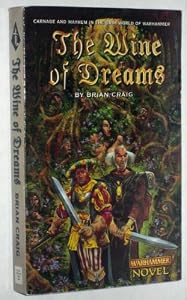
Book review: Wine of Dreams

My, don't I read a lot these days? I read this a while ago, but I am procrastinating as far as painting miniatures goes.


Whether or not this is Brian Craig's best book or not... I would perhaps not go that far. It is one of the earlier Warhammer books when these were perhaps geared a little more towards inspiring roleplaying in the Warhammer World and not so much towards selling the latest revamped army for big battles. But I digress...

This is essentially a coming of age story, as a young boy in a small town in the Empire get involved in the family business as a wine merchant. Riveting, eh? It IS actually surprisingly good. Not because you learn anything about pinot noir or anything like that, but because it offers a nice contrast to the cast of characters in other Warhammer novels who are "merely" badass warrior-types. This book goes a long way on the strength of having essentially "promoted" what would have been supporting cast in any other book where the focus is on warlords and arch villains and such. These are ordinary people facing inordinary things as Chaos creeps up on them, and this works well.

It is difficult to reveal much of the plot without spoiling the whole story for people, so I won't attempt it really. There are indeed horrors right on the doorstep in the little village, and it is foolish to dream of adventures, running after girls, drinking wine...  Nah, it's not fair to paint this as a cautionary tale in that sense, and Craig would perhaps not appreciate it if I suggested that his book has a puritan message. The book does revolve around whether or not Chaos can be handled, managed or perhaps "sipped", and themes such as temptation, curiousity and conflicting loyalties adds depth.

I will pause momentarily to wonder why quite a few of the older Warhammer books seem to feature gypsies, when gypsies are hardly dealt with either in the actual roleplaying game or boardgame. Yes, I know of the strigany/strigoi-stuff, but apart from that, it seems somewhat neglected in the higher level official stuff, yet present in several books. In this book there are gypsies playing a vital part in the story as well, and it all works quite well. They are more or less the only true stock characters. Unlike many other Warhammer books, there are not many purely functional, artificial or two-dimensional characters as such (a stout soldier comes close, but is sufficiently well written). Hooray for that. And for me the idea of dramatic encounters with Chaos in the middle of the otherwise reasonably safe Empire offered a fine contrast to some of the more large scale adventures in other books.

Read this book if you're sick of grandiose "slay the demon, before Chaos claims us all!"-books, grim tales of grim anti-heroes in grim circumstances or ill-disguised sales promotion. This book is not selling anything. Well... maybe wine.

Rating: 4 out of 5. A few annoyances here and there.

Thursday, 5 September 2013

Book Review: Blood For The Blood God

I tend to go for the somewhat older Warhammer-books these days. More on the reasons in another rant, but this is one of them.


C.L. Werner usually delivers, and his writing is rich and his characters cool. Sometimes too cool, perhaps. One does have to accept a certain lack of depth in characters in this sort of lit, and that women are either hideous crones or busty temptresses, that relationships and motives are usually not terribly complicated, and that there is plenty of gore.

It's more or less why I read it...

This book is pure barbarian fiction. It's Conan-stuff, and not involving The Old World as such. It would not require much tweaking to not be a Warhammer-novel at all, and I LIKE that. I hate it when I sense stats, game mechanisms, etc at work. The setting here is so obscure (Chaos Wastes) and ill-defined that it's essentially of no consequence whatsoever, and the only explicit tie with the Warhammer World would be the four great powers, and I am not even sure I recall Slaanesh turning up for the party.

The plot in short: Many years ago a great king was killed by The Skulltaker, Khorne's champion. His kingdom fragmented, and now eight tribes (like the star of chaos, eh? Warhammer cleverness for you.) keep each other in check. Our hero belongs to one of these tribes, and he is somewhat naf, at least to begin with. The skulltaker returns after all this time, wanting the head of every tribal chief, and in order to prevent this, our hero must go on an epic quest for a weapon to slay the Skulltaker.

I am somewhat ashamed to say that I really liked this book. It captured Khorne extremely well, and it lacked subtlety much like you would expect from a book about The Blood God. It probably also lacked surprises, at least major ones.

What's bad about it? I am not particularly fond of Werner's tendency to think up a plot with a massive pattern in it. Not saying twists and turns are required on every page, but you kinda see where the story is going, and thus you go through motions and it taxes the writer's ability to entertain you with descriptions and evocative imagery. It's like watching football, knowing in advance what the score will be. This leads to hyperbole, and the whole thing is close to keeling over into silliness at times. Where your line for "silliness" is drawn will have a massive impact on your enjoyment of this book.

There is a wealth of information about tribes in the Chaos Wastes, and much like in other Werner books (Palace of the Plague God, Wulfrik) we get more depth and humanity added to these eeeeevil hordes that threaten The Old World. This is good. I like the "playthings of the chaos gods"-aspect, and the sense that these people (norse, barbarians, etc) have a raw deal, culture shaped by their environment, personalities, hopes and dreams, etc. Does that then make them less villainous? Perhaps. I don't find that to be such a massive problem, seeing as I have more than 12 summers under my belt.

Rating: 4 out of 5. It does drag for a bit here and there and gets repetitive.

Wednesday, 4 September 2013

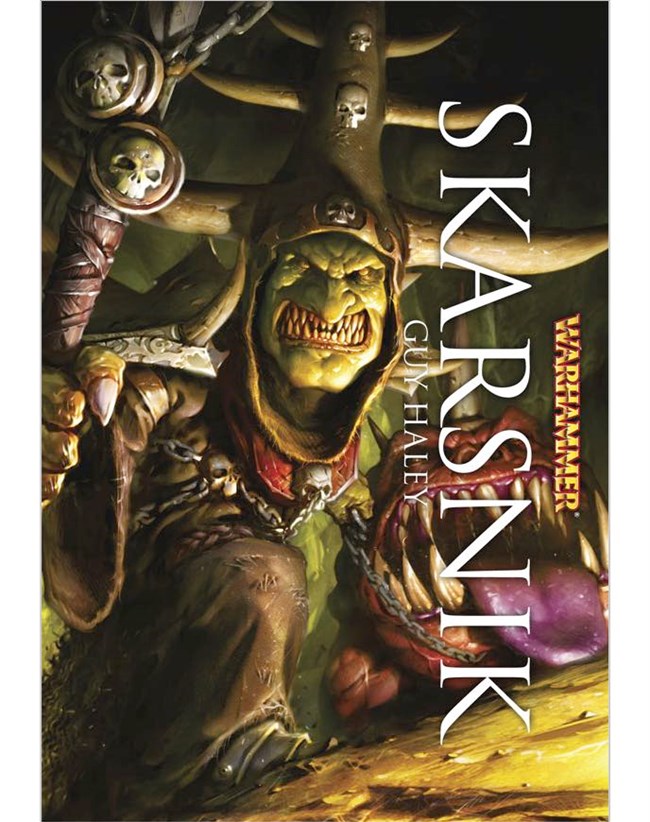
Book review: Skarsnik

I read the book "Skarsnik" by Guy Haley without huge expectations, and thus it does deliver.


I would not want to spoil it by revealing too much of the plot, but to sum up briefly: A playwrite who was abducted by goblins and now sits in an asylum reveals his story to a scholar (and the scholar's companions), and thus we get the story of Skarsnik the goblin king, as told by a human, an epic (?) tale of a rise to power.

Over all the book is well written. The language is diverse, the plot is decent, if not terribly exciting. This seems difficult to avoid when choosing this "teller within the tale"-format, and the ending is somewhat predictable and not very climactic. I put the book down with a sense of "that's that then" and a bit of a shrug. The attempt at a double climax, both the end to the book, and a big battle left me unimpressed.

The book's strength is its wealth of information about goblins and their society and culture. If the book had been a bit more consistent ("goblins don't have friends as much as favourite rivals" ... and yet "bromance" abounds) it would have been even better in that regard. Let me stress that point: It's worth the read JUST for the information, and there is an inspired vision quest along the way.

Skarsnik himself could be a far more interesting figure if Haley had truly gone all out with the "frustrated genius, surrounded by idiots"-angle, and avoided the pitfall of just trying to make him really cool. It falters at times, and the book struggles a bit to give an accurate picture of how smart Skarsnik is. His cunning plans seem somewhat trivial, and his ruthlesness has become quite a fixture in Warhammer-books where dim readers need reminding that the evil main character is indeed NOT to be cheered for. That a reminder is needed that this is indeed a nasty character is not... great.

Balancing goblins between cute, comical, and really nasty is tricky. Haley manages that, but mostly by correcting imbalances with the opposite. ie when the goblins become too cute, he lets them do something extremely brutal. It works somewhat okay.

The dialogue... I hated a lot of it, I must say.

The supporting cast is largely weak. Some of the characters have very little depth, others have stories that just seem to flop without development. That said, there is a pretty cool shaman that goblin-lovers will no doubt love for his stereotypical greatness, and a few others.

I hate it when I read Warhammer books and see game mechanics at work. There's a big battle that reads like a battle report in White Dwarf. There are challenges, descriptions of weapons (fit for a card) and encounters with monsters that never really come to life. Like holding the recipe for the dish you're eating. A strong sense of "I see what you did there" is impossible to shake. To my mind, the writing MUST be strong enough that I don't sit there guessing stats for characters.

"Skarsnik" is a good read, if you like goblins.

Rating: 3 out of 5.