Size comparisons... an old GW blocker a pestigor and a beast of nurgle. Blocker is crouching a little.
Sunday, 15 September 2013
Nurgle team II
I heart pestigors. Both on the pitch and from a design perspective. Alas the GW pestigors are hideous in a bad two-dimensional way, other manufacturers have either made them huge (for ST 3 players at least) or very static and posey. Much as I like a "come at me, bro"-pose, I like chaotic teams a bit more... chaotic.
So these are my plague goats this time around.
Saturday, 14 September 2013
Nurgle team I
I have long been amongst Grandfather's disciples, and I own several nurgle teams at this point. Sadly they perform abysmally and suit my style of play like... an orc suits a math lecture?
Anyway. Here is my most recent beast of nurgle.
Friday, 6 September 2013
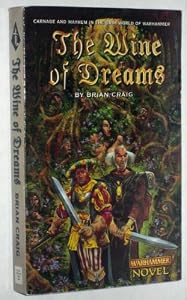
Book review: Wine of Dreams
Whether or not this is Brian Craig's best book or not... I would perhaps not go that far. It is one of the earlier Warhammer books when these were perhaps geared a little more towards inspiring roleplaying in the Warhammer World and not so much towards selling the latest revamped army for big battles. But I digress...
This is essentially a coming of age story, as a young boy in a small town in the Empire get involved in the family business as a wine merchant. Riveting, eh? It IS actually surprisingly good. Not because you learn anything about pinot noir or anything like that, but because it offers a nice contrast to the cast of characters in other Warhammer novels who are "merely" badass warrior-types. This book goes a long way on the strength of having essentially "promoted" what would have been supporting cast in any other book where the focus is on warlords and arch villains and such. These are ordinary people facing inordinary things as Chaos creeps up on them, and this works well.
It is difficult to reveal much of the plot without spoiling the whole story for people, so I won't attempt it really. There are indeed horrors right on the doorstep in the little village, and it is foolish to dream of adventures, running after girls, drinking wine... Nah, it's not fair to paint this as a cautionary tale in that sense, and Craig would perhaps not appreciate it if I suggested that his book has a puritan message. The book does revolve around whether or not Chaos can be handled, managed or perhaps "sipped", and themes such as temptation, curiousity and conflicting loyalties adds depth.
I will pause momentarily to wonder why quite a few of the older Warhammer books seem to feature gypsies, when gypsies are hardly dealt with either in the actual roleplaying game or boardgame. Yes, I know of the strigany/strigoi-stuff, but apart from that, it seems somewhat neglected in the higher level official stuff, yet present in several books. In this book there are gypsies playing a vital part in the story as well, and it all works quite well. They are more or less the only true stock characters. Unlike many other Warhammer books, there are not many purely functional, artificial or two-dimensional characters as such (a stout soldier comes close, but is sufficiently well written). Hooray for that. And for me the idea of dramatic encounters with Chaos in the middle of the otherwise reasonably safe Empire offered a fine contrast to some of the more large scale adventures in other books.
Read this book if you're sick of grandiose "slay the demon, before Chaos claims us all!"-books, grim tales of grim anti-heroes in grim circumstances or ill-disguised sales promotion. This book is not selling anything. Well... maybe wine.
Rating: 4 out of 5. A few annoyances here and there.
Thursday, 5 September 2013
Book Review: Blood For The Blood God
C.L. Werner usually delivers, and his writing is rich and his characters cool. Sometimes too cool, perhaps. One does have to accept a certain lack of depth in characters in this sort of lit, and that women are either hideous crones or busty temptresses, that relationships and motives are usually not terribly complicated, and that there is plenty of gore.
It's more or less why I read it...
This book is pure barbarian fiction. It's Conan-stuff, and not involving The Old World as such. It would not require much tweaking to not be a Warhammer-novel at all, and I LIKE that. I hate it when I sense stats, game mechanisms, etc at work. The setting here is so obscure (Chaos Wastes) and ill-defined that it's essentially of no consequence whatsoever, and the only explicit tie with the Warhammer World would be the four great powers, and I am not even sure I recall Slaanesh turning up for the party.
The plot in short: Many years ago a great king was killed by The Skulltaker, Khorne's champion. His kingdom fragmented, and now eight tribes (like the star of chaos, eh? Warhammer cleverness for you.) keep each other in check. Our hero belongs to one of these tribes, and he is somewhat naf, at least to begin with. The skulltaker returns after all this time, wanting the head of every tribal chief, and in order to prevent this, our hero must go on an epic quest for a weapon to slay the Skulltaker.
I am somewhat ashamed to say that I really liked this book. It captured Khorne extremely well, and it lacked subtlety much like you would expect from a book about The Blood God. It probably also lacked surprises, at least major ones.
What's bad about it? I am not particularly fond of Werner's tendency to think up a plot with a massive pattern in it. Not saying twists and turns are required on every page, but you kinda see where the story is going, and thus you go through motions and it taxes the writer's ability to entertain you with descriptions and evocative imagery. It's like watching football, knowing in advance what the score will be. This leads to hyperbole, and the whole thing is close to keeling over into silliness at times. Where your line for "silliness" is drawn will have a massive impact on your enjoyment of this book.
There is a wealth of information about tribes in the Chaos Wastes, and much like in other Werner books (Palace of the Plague God, Wulfrik) we get more depth and humanity added to these eeeeevil hordes that threaten The Old World. This is good. I like the "playthings of the chaos gods"-aspect, and the sense that these people (norse, barbarians, etc) have a raw deal, culture shaped by their environment, personalities, hopes and dreams, etc. Does that then make them less villainous? Perhaps. I don't find that to be such a massive problem, seeing as I have more than 12 summers under my belt.
Rating: 4 out of 5. It does drag for a bit here and there and gets repetitive.
Wednesday, 4 September 2013
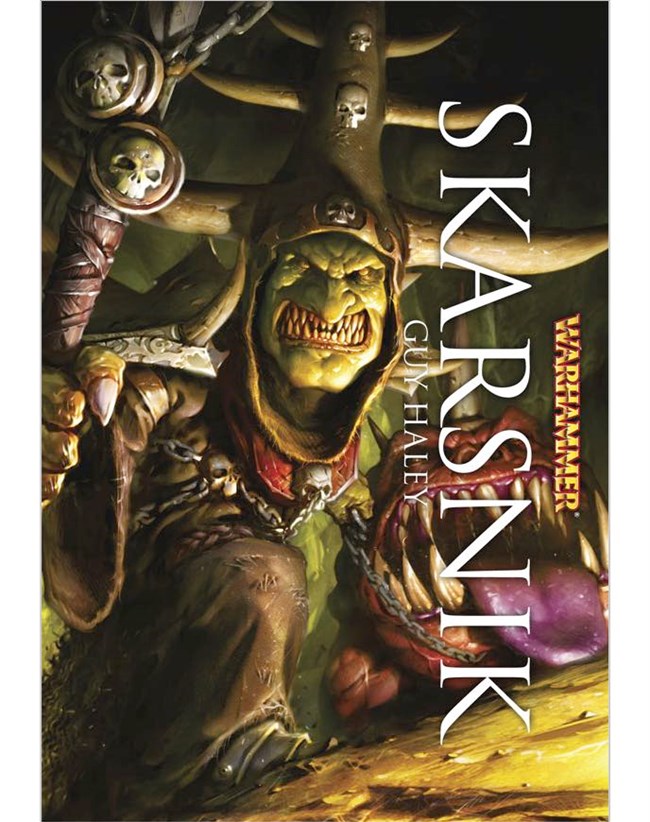
Book review: Skarsnik
I would not want to spoil it by revealing too much of the plot, but to sum up briefly: A playwrite who was abducted by goblins and now sits in an asylum reveals his story to a scholar (and the scholar's companions), and thus we get the story of Skarsnik the goblin king, as told by a human, an epic (?) tale of a rise to power.
Over all the book is well written. The language is diverse, the plot is decent, if not terribly exciting. This seems difficult to avoid when choosing this "teller within the tale"-format, and the ending is somewhat predictable and not very climactic. I put the book down with a sense of "that's that then" and a bit of a shrug. The attempt at a double climax, both the end to the book, and a big battle left me unimpressed.
The book's strength is its wealth of information about goblins and their society and culture. If the book had been a bit more consistent ("goblins don't have friends as much as favourite rivals" ... and yet "bromance" abounds) it would have been even better in that regard. Let me stress that point: It's worth the read JUST for the information, and there is an inspired vision quest along the way.
Skarsnik himself could be a far more interesting figure if Haley had truly gone all out with the "frustrated genius, surrounded by idiots"-angle, and avoided the pitfall of just trying to make him really cool. It falters at times, and the book struggles a bit to give an accurate picture of how smart Skarsnik is. His cunning plans seem somewhat trivial, and his ruthlesness has become quite a fixture in Warhammer-books where dim readers need reminding that the evil main character is indeed NOT to be cheered for. That a reminder is needed that this is indeed a nasty character is not... great.
Balancing goblins between cute, comical, and really nasty is tricky. Haley manages that, but mostly by correcting imbalances with the opposite. ie when the goblins become too cute, he lets them do something extremely brutal. It works somewhat okay.
The dialogue... I hated a lot of it, I must say.
The supporting cast is largely weak. Some of the characters have very little depth, others have stories that just seem to flop without development. That said, there is a pretty cool shaman that goblin-lovers will no doubt love for his stereotypical greatness, and a few others.
I hate it when I read Warhammer books and see game mechanics at work. There's a big battle that reads like a battle report in White Dwarf. There are challenges, descriptions of weapons (fit for a card) and encounters with monsters that never really come to life. Like holding the recipe for the dish you're eating. A strong sense of "I see what you did there" is impossible to shake. To my mind, the writing MUST be strong enough that I don't sit there guessing stats for characters.
"Skarsnik" is a good read, if you like goblins.
Rating: 3 out of 5.
Sunday, 1 September 2013
Minotaur conversion wip 2
I reworked the legs and added fur, pads and gloves. Not sure what I think of him. Looks vicious, at least. Perhaps he is too bestial, but concept-wise I like minotaurs as dangerous, barely controlled monsters, and not "my friend with the bull-head who loves souvlaki".
Maybe he needs some chains.