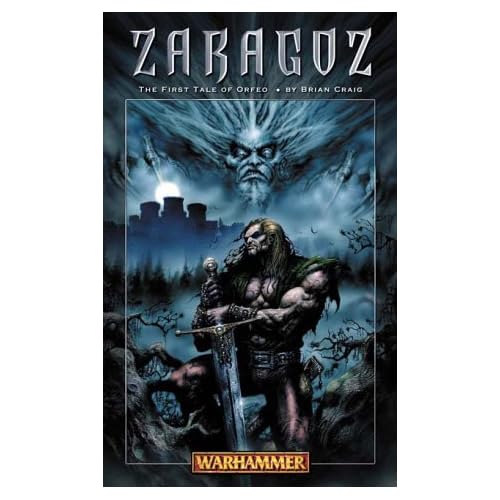
This is part one of three, all completely different books, that are tied together by being the tales of Orfeo, a wandering minstrel-type who is captured by a pirate king somewhere in Araby. His first tale features himself as the main character (the others do not), and it is perhaps the superior story out of the three. The plot - without giving too much away - revolves around the struggle for control of a small Estalian city state where chaos lurks. In terms of genre... Once again, I succeeded in finding a Warhammer book without massive battles, infamous warlords and destruction on a grand scale. This is more fantasy-horror-thriller stuff, though it does drag in parts.
There are two obvious advantages to this book: The settings. It offers rare scraps of info about Estalia and Araby, places largely ignored or passed over quickly by the majority of Warhammer writers. That may have something to do with where the authors are from, but it may also have something to do with the way the Warhammer world has come to be about invasions from the North again and again... Do I like Craig's Eastalia and Araby? I like his Estalia. His Araby is something out of "1001 Nights" with strong dose of Orientalism and some PC "let's not speak ill of this pastiche of that big world religion that some people speak ill of"-sentiment where folks in Araby pretty much appear to be very much like... Arabs. In books for boys, written 100 years or so ago. The Estalians... Well, it smacks of Quijote and (inspiration from?) Shakespeare, Lovecraft and perhaps Dumas, and this is all quite good, with a nice mood and sense of the place and people, generic and Warhammer-deep though it all may be.
Another positive is the way Chaos is portrayed. This is seemingly where Craig and I meet eye to eye. I like it. Chaos is not "thousands of warriors in heavy black armour, come from the North to bash you!" but more of a creeping temptation, something that individuals are seduced and corrupted by, more so than this "forces of darkness!"-shite that there is way too much of in books designed to sell you a new army or something similar. Hell, there's even a philosophically minded character (I won't say who) who tries to explain his involvement with chaos, and how it "works" for lack of a better term. How many Warhammer books have proper attempts at metaphysics? Not many. Most just tend to tell you that within the Chaos realms or wherever daemons are involved, anything can happen. The puppy can talk, okay? It's Chaos! It's a daemonette on a skateboard, okay? It's Chaos! That may work for a young audience or people who fancy a quick "eeew!" reaction, but it does get tedious. If anything, I would have liked more of it, but it may undermine the tale if the characters understand TOO much about how the world(s) work, and appreciate that it can be hard to work in large sections where characters basically just explain themselves.
The plot does drag at times, several characters have next to no personality, and the main character himself, Orfeo, seems an annoying composite of ideas. I hesitate to say it, but he does not get more interesting in the next two books, and he seems to be something of a relic from the early, less fleshed out Warhammer world, representing the sort of "anything goes character" which does not seem to fit in very well in later books.
And lastly: WTF is up with that cover? Did they just put what they thought was a pretty cool picture on the cover? It doesn't seem to have much to do with the book or depict any of the characters, at least not accurately. I have noticed that with quite a few Warhammer books now, and often wondered why.
Rating: 3 or 4 out of 5. Dragged too much and had a gallery 2-D characters.

No comments:
Post a Comment