Thursday, 19 September 2013

Book review: Storm Warriors

Seeing as I read the other two tales of Orfeo, I figured I would read the third one too, even if I was a bit weary of the trilogy after the second installment. Does it pick up, or is this one long rant about mediocrity? Read on and find out.


Orfeo keeps spinning his yarn to the caliph, and he does seem to have regained some of his talent, and we may consider the previous tale something of a detour, or perhaps a lull. Not just in terms of what the hell it had to do with what the caliph was asking about in the first place, but also in terms of its quality as far as plot and characters go.

This tale is quite clearly Arthurian. Throw it away if you hate all things Camelot-Merlin-Knights-related. Does it need to be? Kinda. We do again explore another corner of the Warhammer World, and this time it is Albion (though it could have easily been Bretonnia without too much tweaking). While the previous tale suffered deeply from its generic setting, this one has much more attention to cultural aspects and various traditions. Thumbs up for that, even though I am personally not crazy about Arthurian stuff.

The plot, briefly. Elves are shipwrecked in the small kingdom of Morien where a young, inexperienced and not exactly awesome king Herla must deal with trouble that arises in connection with that. Rifts grow between the king and his bard Trystan, and between the king and queen, the king and his people, the king and his horse, his mates.... Only kidding about the horse, but rifts grow everywhere, and it all comes to a head in the end. No surprise there.

There are two protagonists as such, Herla and Trystan. Are they gay then? No, I wouldn't say that. They just seem to embody two aspects of Morien's culture and this is fine. Unless one hates the bard-cum-wizard role or something like that. They do have some depth of character, but they are both, as I see it, embodiments of principles, arch- or stereotypes, and somewhat without surprising depths or frailties. Be that as it may, they are after all characters in a tale within a tale, Orfeo's teaching tools, if you will. The other characters... Good enough. No complaints here, really.

Oh come on, you've guessed already that those elves are fishy.

I am perfectly ready to admit that I am no expert in Arthurian lore, so various references, homages or pastiches may have been beyond me. I know enough to detect the undercurrent (that doesn't take much), and I also get the reinvention of The Wild Hunt as the Storm Warriors, even without a strong passion for Celtic myth. People who love this stuff more than I do, may either love or hate this book more than I do. You'll see Merlin, Arthur, shades of Lancelot... Probably more than that.

The other two books dragged in places. This one does too. Let's assume that it's not Orfeo who tells boring tales to the caliph, and let's assume that HE is not paid per word or expected to fill a certain number of pages... See where I am going with this? I think an editor with a red pen would have helped. Such an editor might have crossed out stuff that even slow kids had already gotten, or he might have written "unclear" when it came to certain passages.

Chaos, again, creeps up, rather than invade with heavy armour, horned helmets and big axes. It lurks and pounces on the morally weak, sticks a talon in shortcomings, spreads like a disease, and doesn't just punch you in the face. This is what I like best in Craig's books. The demand for "heroes" who are strong in character, not just in sword arm... it's a plate full of vegetables without much meat, and without a dessert. It makes these books a bit boring at times, it makes the heroes less cool than quite a lot of other characters in Warhammer books, and yet it does not really offer enough food for thought and moral complexity to sort of leap out of its genre (fantasy schlock?). That is of course a problem, but it seems inherent, or structural. The second problem in the trilogy is predictability, but again, many Warhammer books suffer from this, and twist endings can end up contrived and annoying as well, so... Meh.

Rating: 3 or 4 out of 5. Rivals the first book as the best in the series.

Nurgle team VII

Two more rotters. These are a bit less dynamic, but hey, if you were sick and your stat line was average... one has bigger arms, hoping to ST up one day, perhaps.

Wednesday, 18 September 2013

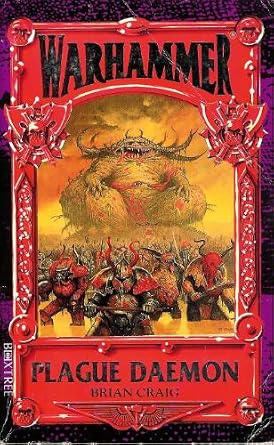
Book Review: Plague Daemon

There are many reasons why I read this book. They are, in no particular order:

1. I read all the Warhammer books I can find that feature Nurgle-stuff.

2. It is the second tale of Orfeo, and I read the first one and liked it.

3. I have liked Brian Craig's other books.

4. I like the earlier, older Warhammer books better than the new ones.

5. It is set in yet another not so familiar region of the Old World.


All these reasons, however, took on the guise of daemons themselves, and they became the very source of my disappointment.

I did not like this book. While there is some development of the metaplot that features Orfeo and his captor from the first book (and this I liked, overall), the tale itself is damn near daft and fairly uninteresting at best. It's the tale of a man-at-arms (and so we are told repeatedly) with the personality of a pack of lunch meats and his struggle to save a small kingdom in The Border Princes from the clutches of the plague god, Nurgle. Again, without revealing much, I think one can say that this features treachery, wizardry and douchebaggery.

I struggled to find one interesting character in the entire book. For the life of me, I could not care less what happened to these people. If Craig (ambitiously) wanted his characters to be more ordinary, "cometh the hour, cometh the man"-type of heroes then... Well, it was a fine thought, but I don't think it succeeded in its execution. It's a difficult task to let your characters mature and blossom into heroes, and they often start out too lame, or go through too much of a transformation. In this case it's more of the former, and it is somewhat predictable as well.

How good is the writing, how rich and powerful the imagery? Not very. While I would be a hypocrite if I asked for the very blood, gore and action that later Warhammer novels offer in spades, I struggled to find excitement in even the most climactic scenes. The plot just sort of drudged along, and the whole thing did feel very much like a tale. A boring one at that, and this book, weaker in terms of plot than the first one, really needed some extra colour... You know, people diving in slow motion as stuff explodes. Nothing ever did.

Is this - like some of the other books I have read and reviewed - a treasure of knowledge? Will wisdom be yours if you read it? Alas, no. The Border Princes, much like Norsca, Chaos Wastes etc. is one of the less charted regions of the Warhammer world, and thus it offers the chance to have any sort of kingdom located there that you may want or need. While it's hardly feasible to go on and on describing details about a place and its culture, this all came across as very generic. It could almost literally be anywhere. As for Nurgle-stuff... Nothing new, no deep insights.

This felt very much like a part two of a trilogy. I yawned, I soldiered on, but I was not terribly amused or impressed. I have definitely seen better from this author, so I was somewhat frustrated by this book.

Rating: 2 out of 5. Boring, a missed boat.

Nurgle team VI

I actually like the gw rotters, but nevertheless I have still made my own.

I see rotters as sick humans, so I tried to keep them at that size. Also my warriors are not huge, and it looks silly if the rotters are bigger.

Tuesday, 17 September 2013

Nurgle team V

Here are the other two warriors, ready to rumble for the crow god.

I gave them fatter legs, footballer's thighs and did some work on their bellies. You cant tell in the picture, no.

Monday, 16 September 2013

Book review: Zaragoz - Orfeo trilogy 1

Here's another of the older Warhammer books that I enjoyed.


This is part one of three, all completely different books, that are tied together by being the tales of Orfeo, a wandering minstrel-type who is captured by a pirate king somewhere in Araby. His first tale features himself as the main character (the others do not), and it is perhaps the superior story out of the three. The plot - without giving too much away - revolves around the struggle for control of a small Estalian city state where chaos lurks. In terms of genre... Once again, I succeeded in finding a Warhammer book without massive battles, infamous warlords and destruction on a grand scale. This is more fantasy-horror-thriller stuff, though it does drag in parts.

There are two obvious advantages to this book: The settings. It offers rare scraps of info about Estalia and Araby, places largely ignored or passed over quickly by the majority of Warhammer writers. That may have something to do with where the authors are from, but it may also have something to do with the way the Warhammer world has come to be about invasions from the North again and again... Do I like Craig's Eastalia and Araby? I like his Estalia. His Araby is something out of "1001 Nights" with strong dose of Orientalism and some PC "let's not speak ill of this pastiche of that big world religion that some people speak ill of"-sentiment where folks in Araby pretty much appear to be very much like... Arabs. In books for boys, written 100 years or so ago. The Estalians... Well, it smacks of Quijote and (inspiration from?) Shakespeare, Lovecraft and perhaps Dumas, and this is all quite good, with a nice mood and sense of the place and people, generic and Warhammer-deep though it all may be.

Another positive is the way Chaos is portrayed. This is seemingly where Craig and I meet eye to eye. I like it. Chaos is not "thousands of warriors in heavy black armour, come from the North to bash you!" but more of a creeping temptation, something that individuals are seduced and corrupted by, more so than this "forces of darkness!"-shite that there is way too much of in books designed to sell you a new army or something similar. Hell, there's even a philosophically minded character (I won't say who) who tries to explain his involvement with chaos, and how it "works" for lack of a better term. How many Warhammer books have proper attempts at metaphysics? Not many. Most just tend to tell you that within the Chaos realms or wherever daemons are involved, anything can happen. The puppy can talk, okay? It's Chaos! It's a daemonette on a skateboard, okay? It's Chaos! That may work for a young audience or people who fancy a quick "eeew!" reaction, but it does get tedious. If anything, I would have liked more of it, but it may undermine the tale if the characters understand TOO much about how the world(s) work, and appreciate that it can be hard to work in large sections where characters basically just explain themselves.

The plot does drag at times, several characters have next to no personality, and the main character himself, Orfeo, seems an annoying composite of ideas. I hesitate to say it, but he does not get more interesting in the next two books, and he seems to be something of a relic from the early, less fleshed out Warhammer world, representing the sort of "anything goes character" which does not seem to fit in very well in later books.

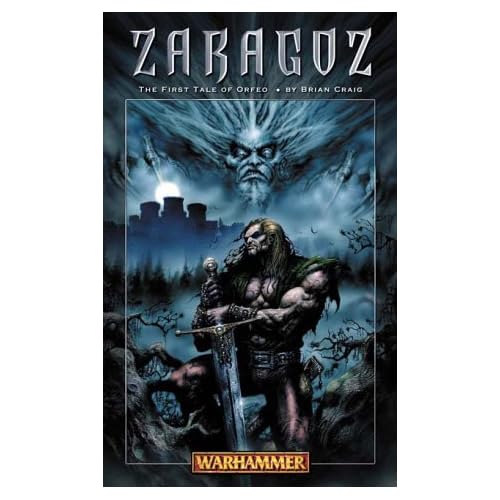
And lastly: WTF is up with that cover? Did they just put what they thought was a pretty cool picture on the cover? It doesn't seem to have much to do with the book or depict any of the characters, at least not accurately. I have noticed that with quite a few Warhammer books now, and often wondered why.

Rating: 3 or 4 out of 5. Dragged too much and had a gallery 2-D characters.

Nurgle team IV

Next up a couple of warriors.

I thought about making them truly fat, but settled on just a mild overweight and no specific mutations.